The World Bank in the Spotlight: Financing an Industry Killing Sustainable Development
A new report by Stop Financing Factory Farming has a simple message: billions intended for sustainable development is still flowing into factory farms, super‑charging nature loss and pollution in countries already suffering from climate shocks and extreme heat. And because the same industrial meat and dairy giants also borrow from high‑street banks, this is not just a development bank problem - it is a story that runs right through the mainstream financial system.
Loading image...S3F – The Coalition Behind the Report
Stop Financing Factory Farming (S3F) is a global coalition of more than 30 groups campaigning to end the funding of industrial animal agriculture by international development banks. They work with communities to push powerful lenders like development banks to stop backing industrial meat and dairy – an industry that is catastrophic to public health, climate and sustainable development.
They focus on institutions like the International Finance Corporation (IFC), the private‑sector arm of the World Bank Group. This is important because their rules are copied by dozens of other development banks and many commercial banks. That means when IFC gets factory farming wrong, a big chunk of the global financial system tends to copy‑paste the same mistakes.
On the other hand, if development banks were to get things right - by meaningfully supporting sustainable food systems – the spillover effects on the rest of the financial sector would be huge. That’s why their current approach is so worrying, but the opportunity is so great if they cleaned up their operations.
What This New Report Reveals
Between 2020 and 2025, IFC approved 38 industrial animal agriculture projects - almost US$2 billion to meat, dairy, and feed operations in countries already feeling the heat of climate shocks and ecological breakdown.
The report asks a basic, human question: if factory farming is so damaging, are IFC’s clients at least following the World Bank’s own environmental rules on biodiversity, pollution, and water and energy use?
Too often, the answer is no - or “we don’t really know.” Many projects skip key assessments, gloss over risks, or promise to fix problems later without showing whether that ever happens.
On paper, there are strong safeguards, however on the ground, communities and ecosystems are frequently left carrying the cost.
The Scale of the Problem
Livestock already produces more emissions that all transport combined, occupies about 70% of all agricultural land, and threatens more than 17,900 species.
Yet IFC continues to pour money into the same industrial model - mass confinement of animals, vast manure lagoons, and huge tracts of land torn apart to make way for a single feed crop - without consistently enforcing the protections it has written into its own rulebook.
How Factory Farming Wreaks Havoc on the Planet
Industrial animal agriculture is like building a global pollution machine and running it 24/7. It crams thousands of animals into sheds, pipes in imported feed, and pipes out waste, emissions, and slaughter by‑products—usually far faster than surrounding landscapes and waterways can cope.
Biodiversity Loss
To feed billions of farmed animals, forests, savannas and rich ecosystems are cleared for soy and maize, and natural grasslands are turned into pasture. Animal agriculture has now engulfed roughly 30% of the planet’s land surface, pushing wildlife into smaller, more fragmented pockets. More than 17,900 species are now directly threatened by livestock farming.
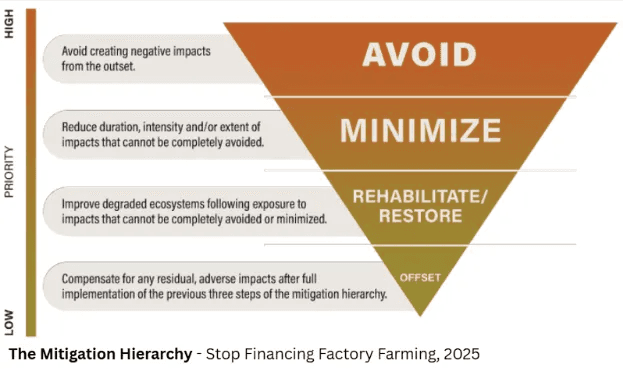
The report shows that many IFC‑backed projects sit in or source from these pressured landscapes, while giving only sketchy information about habitat or supply chain impacts. Instead of clearly avoiding sensitive areas, some projects rely on vague mitigation measures or a single biodiversity “offset” to balance long‑term damage.
Pollution: Air, Water, and Waste
Factory farms don’t just smell bad; they pump out ammonia, methane, nitrous oxide, and fine particles that damage nearby air quality and contribute to climate change. Manure and slaughter waste loaded with nutrients and pathogens seep into rivers and groundwater, driving algal blooms, dead zones, and unsafe drinking water.
These cause immense harm to rural and low‑income communities., who bear the brunt of industrial mega-farms, and see incredibly little benefit.
The IFC should function to help these communities, but the report finds that many IFC projects either skip full pollution assessments or look at only part of the picture, such as ignoring cumulative impacts from multiple sites in the same area. Several projects are not compliant with emissions or wastewater standards at the time they are approved; instead, the promise is “we’ll fix it later,” with limited public follow‑up.
Precious Resources: Water and Energy
Industrial meat and dairy burn through water and energy at every stage - from thirsty feed crops to chilled slaughter lines and energy‑hungry cold stores. Global livestock production uses more than 4,000 cubic kilometres of water each year for feed, forage, and grazing, yet animal products provide only a fraction of humanity’s calories.
Even so, only a small handful of IFC‑backed projects can demonstrate efficiency in their water and energy use or that they are taking the basic first step of avoiding unnecessary consumption. Most report partial fixes or no real data at all, locking communities into sharing scarce water and power with giant livestock operations.
Loading image...Why This Matters for Retail Banks
Although this report focuses on IFC, its message lands squarely in the laps of commercial banks too. IFC’s Performance Standards are widely copied across the banking sector; if they are weakly applied here, they are likely weakly applied in many other places too.
For banks, the choices are now clear. Industrial animal agriculture is a major driver of climate change, nature loss, pollution, and water stress, and it is very hard to square that with net‑zero, “nature‑positive,” or ESG marketing claims.
This report gives banks a roadmap to do better: tighten due diligence, stop financing expansion of highly damaging factory farms, and shift capital into plant‑rich food systems.
Your Power Has Never Been Easier to Use
You do not need to be a finance expert to have influence here. Your everyday bank account is part of this story because banks use customer deposits to make loans and investments - including to agribusiness giants.
Here are two simple but hugely impactful steps you can take today:
1. Check your bank on Bank for Nature
Check out your bank. You will see at a glance whether it finances factory farming. Is it free‑riding on the planet, or taking nature seriously?
2. Message your bank through Bank for Nature
Whilst there, use the built‑in function on your bank’s page to send a short, clear message – more quickly than you can name my favourite shark, the Tasselled Wobbegong (trust me, it’s real)
It takes a few minutes, costs nothing, and tells your bank that customers are watching how it treats animals, people, and the planet. In a world where billions are still flowing into factory farms, that kind of pressure from account‑holders really can shift the story.
Want more research like this?
Subscribe to the only source dedicated to factory farm finance!